
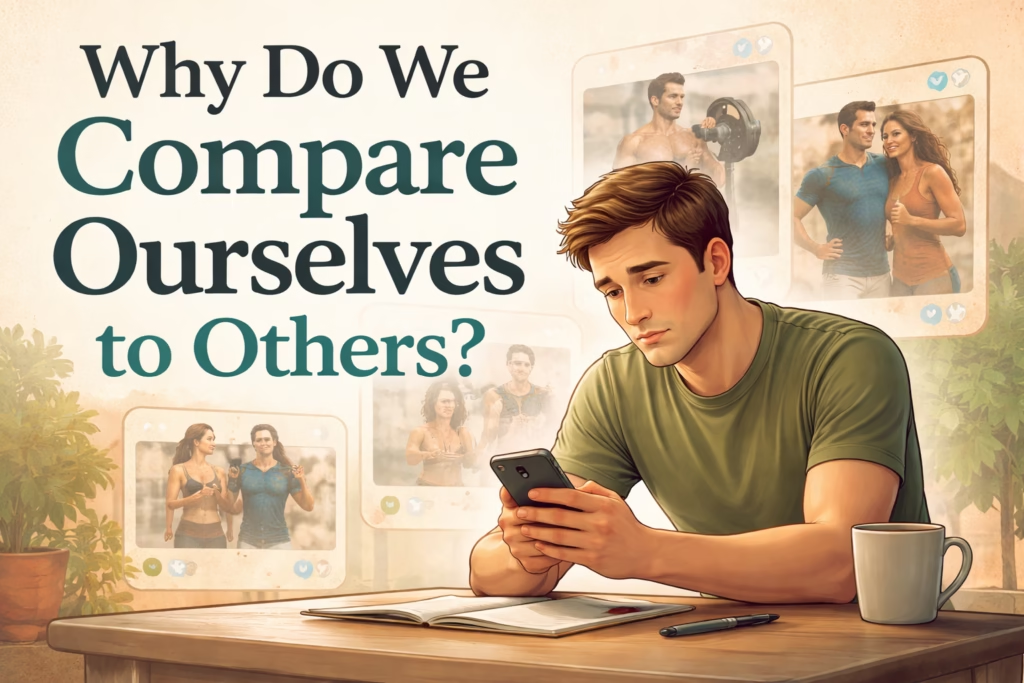
Why do we compare ourselves to others? Most of us don’t do it because we are naturally insecure or unhappy. We compare ourselves to others because our brains are hardwired to seek direction, measure progress, and figure out where we stand in our daily lives.
For many people, social comparison shows up quietly: a quick scroll through social media, or a glance at a colleague who seems to have it all together. Suddenly, a familiar thought takes over: “Everyone else has it figured out, and I don’t.” That single thought can drain your motivation instantly—even when your life is going well. Learning how to reframe social comparison is essential for building sustainable mental habits.
Key Takeaways:
- It is psychological: Social comparison is an evolutionary drive to evaluate personal standing when objective benchmarks are missing.
- Social media distorts reality: You are comparing your daily raw footage to someone else’s carefully curated highlight reel.
- Comparison is feedback: Feeling envious usually signals a desire for growth, direction, or a clearer personal goal.
The Psychology Behind Why We Compare Ourselves to Others
Social comparison is built directly into human survival biology. Historically, humans evaluated themselves against small tribal groups to understand their roles, strengths, and relative safety. In modern psychology, this is known as Social Comparison Theory.
According to the American Psychological Association (APA), social comparison helps individuals evaluate their own opinions and abilities when objective, clear benchmarks are absent. In simple terms: when you feel uncertain about your personal growth, career path, or relationships, your brain instinctively looks outward to gather data.
Upward vs. Downward Social Comparison
Psychologists divide social comparison into two primary types:
- Upward Comparison: Comparing yourself to people you perceive as superior or more successful. While this can inspire growth, it often triggers feelings of inadequacy.
- Downward Comparison: Comparing yourself to those who are worse off. While this can provide a temporary ego boost, it rarely leads to long-term personal fulfillment.
Why Social Media Makes Social Comparison Worse
Historically, you compared yourself to a handful of peers in your immediate community. Today, social media algorithms expose your brain to thousands of hyper-optimized highlights every single day. This creates a massive contextual disconnect.
When you view someone else’s social media feed, you don’t see the years of consistency, the trade-offs, or the personal failures behind their achievements. You only see performance output. When a peer excels at something specific, your mind makes a false generalization: “They are good at everything, and I am good at nothing.”
Why We Compare Ourselves When Seeking Life Direction
Comparison is rarely driven purely by envy. More often, it is driven by an underlying desire for purpose, structure, and direction. When you see someone else thriving, your brain asks deeper internal questions:
- Am I making meaningful progress in my life?
- Am I focusing my energy on the right priorities?
- Am I becoming the person I want to be?
Even successful professionals and dedicated parents can feel lost when these core questions lack clear answers. Comparison hurts most when your personal identity and long-term values feel blurry.
How Constant Comparison Kills Motivation and Focus
In theory, observing someone else succeed should act as inspiration. In practice, modern comparison skips constructive learning and jumps straight to self-criticism. Instead of asking, “What actionable habit can I learn from them?” the brain concludes, “I am falling behind.”
Once social comparison turns into harsh internal judgment, personal momentum collapses. This cycle often manifests as:
- Decreased Motivation: Tasks feel heavy and pointless when you assume others are moving faster.
- Decision Paralysis: Second-guessing your direction leads to inaction rather than positive changes.
- Imposter Syndrome: Discounting your own hard-won achievements because someone else’s progress looks larger.
What Comparison Is Actually Signaling to Your Brain
Comparing yourself to others is not proof of failure or inadequacy—it is simply psychological feedback. Most often, social comparison signals three key insights:
- You lack a clear personal metric: You haven’t defined what “success” looks like on your own terms, so you borrow someone else’s definition.
- You are consuming inspiration without action: You are spending more energy watching other people build their lives than you are building your own through small, daily execution.
- You care about growth in that specific area: If seeing someone else excel in fitness or business sparks comparison, it means that domain matters deeply to you.
If you want to dive deeper into breaking this mental cycle, read our complete guide on Why You Should Stop Comparing Yourself to Others.
Frequently Asked Questions About Social Comparison
Is comparing yourself to others always bad?
No. When used constructively (known as positive reference comparison), observing others can provide a roadmap for skills you want to develop. It becomes harmful only when it turns into self-worth judgment.
Why do I compare myself to others even when I am happy?
Because comparison is an automatic pattern driven by uncertainty or routine exposure to external highlights (like social media), not necessarily baseline unhappiness.
Final Thoughts
So, why do we compare ourselves to others? Because we want clarity, direction, and reassurance that we are on the right path. Comparison itself isn’t a character flaw—it is a deeply ingrained human mechanism. The key is to stop letting comparison define your self-worth, and start using it as data to refine your own path.