

Is It Normal to Talk to Yourself? What It Actually Means

Is it normal to talk to yourself? Short answer: yes—completely normal.
Many people do it while thinking, working, or processing emotions. If you’ve ever caught yourself narrating a task, rehearsing a conversation, or giving yourself a pep talk, you’re not alone.
In this article, you’ll learn why people talk to themselves, when it’s helpful, and when it’s worth paying attention to the tone of your self-talk.
Why Do People Talk to Themselves?
Talking to yourself isn’t random. It’s a cognitive tool your brain uses when mental load exceeds comfort. When thoughts, emotions, or decisions pile up, verbalizing them externalizes the process, making it easier to manage.
In simple terms: your brain uses language to regain control.
Here’s what’s actually happening in each case.
1) To process thoughts and reduce mental overload
Your brain can hold only a limited number of active thoughts at once. When too many compete for attention, they blur together and feel overwhelming.
Speaking thoughts out loud:
-
Slows them down
-
Forces sequence and structure
-
Turns vague concerns into defined problems
That’s why saying “Okay, here’s what I know” often brings relief. You’re converting abstract noise into something concrete your brain can work with.
This is especially common during decision-making or problem-solving.
2) To direct attention and maintain focus
Self-talk works like an internal instructor. It helps your brain prioritize what matters right now, instead of reacting to distractions.
Short phrases like:
-
“One thing at a time”
-
“Finish this part first”
-
“Stay learn mode, not panic mode”
act as mental guardrails. They keep your attention from drifting, especially when tasks are boring, complex, or unfamiliar.
This is why people often talk to themselves while assembling things, learning new skills, or working under pressure.
3) To regulate emotions in real time
When emotions spike, logic tends to drop. Self-talk helps bridge that gap.
Saying things like:
-
“I’m frustrated, not failing”
-
“This reaction makes sense”
-
“Pause before responding”
activates parts of the brain associated with emotional regulation rather than reactivity.
In other words, talking to yourself can interrupt emotional spirals before they take over. It’s one of the fastest ways people instinctively calm themselves without external help.
4) To reinforce motivation and persistence
Motivation isn’t constant. It fluctuates based on energy, stress, and confidence.
Self-talk fills the gap when motivation drops by:
-
Reinforcing purpose
-
Normalizing discomfort
-
Encouraging continuation rather than quitting
Statements like “Just five more minutes” or “This is hard, not impossible” aren’t hype — they’re psychological nudges that help you push through resistance without overwhelming yourself.
This is why athletes, professionals, and even children naturally use self-talk during effortful tasks.
Is Talking to Yourself a Sign of Intelligence?
It can be a sign of good thinking habits, especially when it’s used intentionally. Many people use self-talk to improve performance and problem-solving. When you put your thoughts into words, it can help with:
- Remembering steps and details
- Making decisions more clearly
- Sticking with a task when it’s difficult
When Talking to Yourself Is Helpful
Self-talk tends to help most when it’s constructive and forward-moving. Helpful self-talk often:
- Breaks problems into smaller steps
- Encourages progress instead of perfection
- Helps you reflect instead of react
Examples of helpful self-talk:
- “This is uncomfortable, but it’s temporary.”
- “What’s the next small step I can take?”
- “I can handle this one part right now.”
When Self-Talk Can Become a Problem
Talking to yourself is normal. However, the tone matters. It may be worth paying attention if your self-talk is:
- Constantly harsh or self-critical
- Repetitive and stuck on past mistakes
- Fueling anxiety instead of calming it
There’s a difference between reflection and rumination. Reflection helps you learn and move forward. Rumination keeps you replaying the same fear or mistake.
If your self-talk feels distressing, out of control, or is significantly affecting your daily life, consider speaking with a qualified professional. Most of the time, though, everyday self-talk is not a red flag—it’s just a human brain doing human brain things.
Talking to Yourself Out Loud vs. In Your Head
Both are normal.
- Internal self-talk is quieter and more common in social settings.
- Out-loud self-talk often happens when you’re alone, stressed, or deeply focused.
Speaking out loud can feel more grounding because it engages more of your senses.
How to Use Self-Talk in a Healthier Way
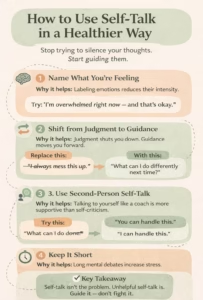
Instead of trying to stop talking to yourself, try guiding it. Here are a few simple habits you can use immediately:
1) Name what you’re feeling
Try: “I’m overwhelmed right now, and that’s okay.”
2) Shift from judgment to guidance
Replace: “I always mess this up”
With: “What can I do differently next time?”
3) Try second-person phrasing
Some people find “You can handle this” more supportive than “I can handle this.”
4) Keep it short
Short phrases work best when you’re stressed.
If you want a related read, check out Why You Should Stop Comparing Yourself to Others.
For a deeper external explainer, you can also review Healthline’s mental health resources.
Final Thoughts
Is it normal to talk to yourself? Yes. It’s common, human, and often helpful.
The goal isn’t silence—it’s awareness.
When you learn to notice your self-talk and gently shape it, it can become one of your most useful tools for focus, calm, and consistency.